

Crunches are one of the most popular and effective core exercises for strengthening your abdominal muscles and improving overall core stability. Whether you’re a fitness beginner looking to build foundational strength or an experienced athlete aiming to enhance your core power, mastering proper crunch technique is essential for achieving optimal results while preventing injury. This comprehensive guide will walk you through everything you need to know about performing crunches correctly, from basic form to advanced variations, ensuring you get the most out of this fundamental exercise.
Understanding Crunches: The Basics
Crunches are a bodyweight exercise that primarily targets your rectus abdominis, commonly known as the “six-pack” muscles that run vertically along the front of your abdomen. Unlike sit-ups, crunches involve a smaller range of motion, focusing specifically on the contraction of your abdominal muscles without engaging your hip flexors as much.
The primary muscles worked during crunches include:
- Rectus abdominis: The main target muscle responsible for flexing your spine
- Obliques: Side abdominal muscles that assist in the movement
- Transverse abdominis: Deep core muscle that provides stability
One of the greatest advantages of crunches is that they require no equipment – just your body weight and a comfortable surface. While an exercise mat can provide additional comfort and cushioning, it’s not essential. This makes crunches an accessible exercise that you can perform anywhere, whether at home, in the gym, or while traveling.
For optimal results, crunches are best incorporated into your workout routine 2-3 times per week, allowing adequate recovery time between sessions. They can be performed as part of a dedicated core workout, integrated into full-body training sessions, or used as a finisher after your main workout routine.
Step-by-Step Instructions: How to Do Basic Crunches
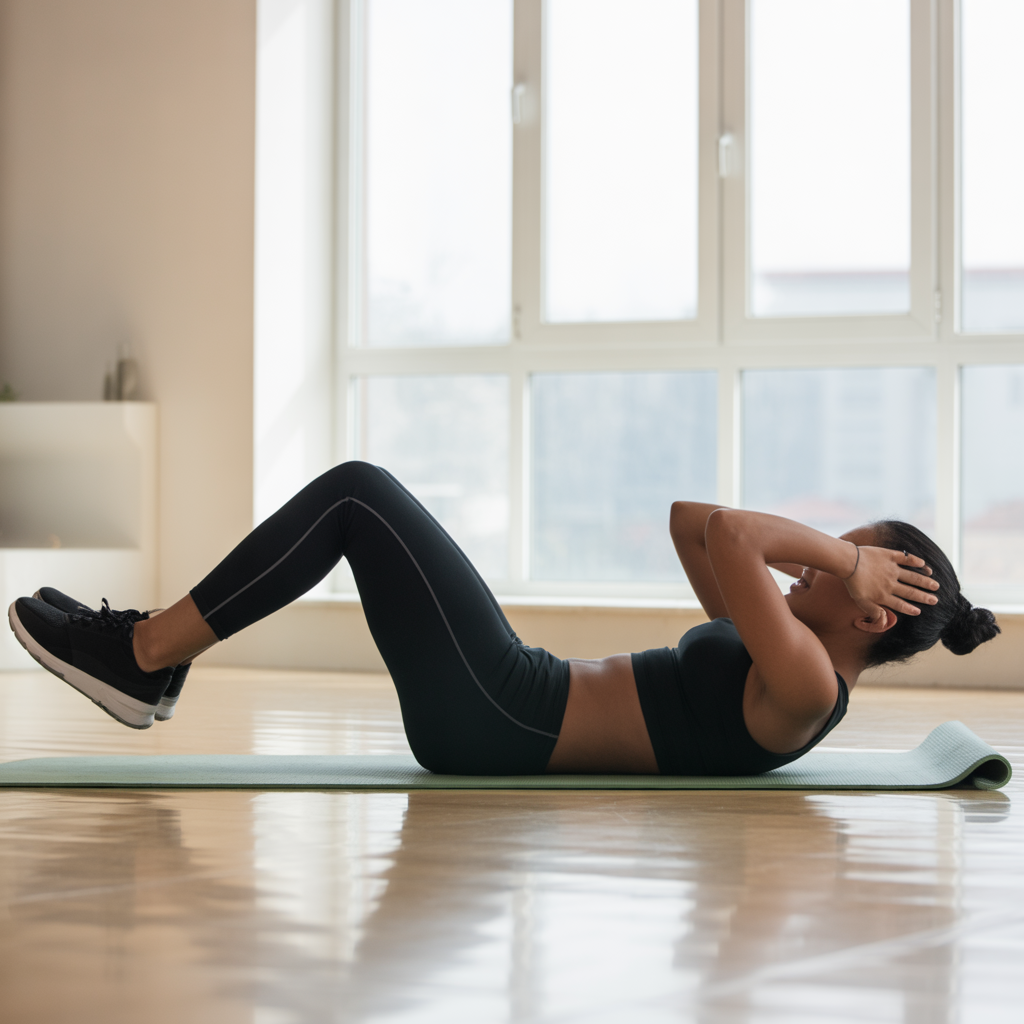
Follow these detailed steps to perform a perfect crunch:
Starting Position Setup
- Lie flat on your back: Begin by lying on a firm surface with your entire back pressed against the floor
- Bend your knees: Position your knees at approximately 90 degrees with your feet flat on the floor, hip-width apart
- Position your hands: You have three options for hand placement:
- Lightly place fingertips behind your ears (avoid interlacing fingers)
- Cross your arms over your chest
- Keep your arms at your sides
- Engage your core: Gently draw your navel toward your spine to activate your deep core muscles
The Movement Execution
- Initiate the movement: Exhale as you slowly lift your head, neck, and shoulder blades off the ground
- Focus on the contraction: Use your abdominal muscles to curl your upper body toward your knees, not your hip flexors
- Maintain proper range: Lift only until your shoulder blades clear the floor – typically 2-4 inches
- Hold briefly: Pause for a moment at the top of the movement to maximize muscle contraction
- Control the descent: Slowly lower back to the starting position while inhaling, maintaining tension in your core
Proper Form and Technique Tips
Mastering proper form is crucial for maximizing the effectiveness of crunches while minimizing injury risk. Here are the key technical points to focus on:
Critical Form Points
- Keep your lower back pressed to the floor: Maintain the natural curve of your spine by keeping your lower back in contact with the ground throughout the movement
- Avoid neck strain: Never pull on your head or neck. If your hands are behind your head, use them only for light support
- Control the movement: Perform each repetition slowly and deliberately, taking 2-3 seconds to lift and 2-3 seconds to lower
- Quality over quantity: Focus on perfect form rather than rushing through high repetitions
Breathing Technique
Proper breathing enhances core activation and exercise effectiveness:
- Exhale during exertion: Breathe out as you crunch up, which naturally engages your core muscles
- Inhale during relaxation: Breathe in as you lower back to the starting position
- Never hold your breath: Continuous breathing ensures adequate oxygen delivery to your muscles
Common Mistakes to Avoid
Understanding and avoiding these common errors will help you get the most from your crunch workouts:
Technical Errors
- Pulling on the neck or head: This can lead to neck strain and reduces abdominal muscle activation. Keep your hands light and use your core to lift
- Using momentum: Rapid, jerky movements rely on momentum rather than muscle strength. Always maintain control throughout the entire range of motion
- Lifting too high: Going beyond shoulder blades clearing the floor doesn’t increase effectiveness and can strain your lower back
- Arching the back: Lifting your lower back off the ground shifts work away from your abs and can cause injury
- Holding your breath: This can increase blood pressure and reduce exercise efficiency
Programming Mistakes
- Prioritizing quantity over quality: Performing hundreds of sloppy crunches is less effective than doing fewer with perfect form
- Training every day: Your core muscles need recovery time just like other muscle groups
- Neglecting other core exercises: Crunches alone won’t develop complete core strength; incorporate variety in your routine
Crunch Variations for Different Fitness Levels

As you progress in your fitness journey, these variations will help you continue challenging your core muscles:
Beginner Modifications
- Assisted crunches: Place a rolled towel behind your lower back for additional support
- Partial range crunches: Lift only your head and neck off the ground until you build strength
- Wall-supported crunches: Rest your feet against a wall to maintain proper knee and hip positioning
Intermediate Variations
- Reverse crunches: Lift your knees toward your chest while keeping your upper body on the ground
- Bicycle crunches: Combine crunching with alternating knee-to-elbow movements
- Oblique crunches: Crunch diagonally to target your side abdominal muscles
Advanced Progressions
- Weighted crunches: Hold a weight plate or dumbbell across your chest for added resistance
- Decline crunches: Perform crunches on a declined bench to increase difficulty
- Cable crunches: Use a cable machine for consistent resistance throughout the movement
- Stability ball crunches: Perform crunches on an exercise ball to engage stabilizing muscles
Programming and Workout Integration
Proper programming ensures consistent progress while allowing adequate recovery:
Sets and Repetitions Recommendations
- Beginners: Start with 1-2 sets of 10-15 repetitions, focusing on learning proper form
- Intermediate: Progress to 2-3 sets of 15-25 repetitions with perfect technique
- Advanced: Perform 3-4 sets of 25+ repetitions or incorporate weighted variations
Frequency Guidelines
Train your abdominal muscles 2-3 times per week, allowing at least 48 hours of recovery between sessions. Your core muscles, like all muscle groups, need time to repair and strengthen between workouts.
Combining with Other Exercises
Crunches work best as part of a comprehensive core routine that includes:
- Planks and side planks for isometric strength
- Dead bugs for core stability
- Mountain climbers for dynamic core engagement
- Russian twists for rotational strength
Safety Considerations and Precautions
While crunches are generally safe for most people, certain conditions may require modifications or alternatives:
Who Should Exercise Caution
- Lower back issues: Those with herniated discs or chronic lower back pain should consult a healthcare professional before performing crunches
- Neck problems: Previous neck injuries may be aggravated by improper crunch technique
- Pregnancy: Pregnant women, especially after the first trimester, should seek medical guidance before continuing abdominal exercises
Warning Signs to Watch For
Stop exercising immediately if you experience:
- Sharp or shooting pain in your back or neck
- Dizziness or lightheadedness
- Severe muscle cramping
- Any pain that persists after exercise
Injury Prevention Tips
- Always warm up: Perform 5-10 minutes of light cardio and dynamic stretching before core work
- Progress gradually: Increase repetitions and intensity slowly over time
- Listen to your body: Rest when needed and don’t push through pain
- Maintain proper hydration: Drink water before, during, and after exercise
Maximizing Results: Additional Tips

To get the most from your crunch routine and achieve your fitness goals, consider these additional strategies:
Complementary Exercises
While crunches are effective, a well-rounded core program should include:
- Plank variations: Build isometric strength and endurance
- Compound movements: Squats, deadlifts, and overhead presses naturally engage your core
- Functional movements: Exercises that mimic daily activities and sports movements
- Flexibility work: Stretching and mobility exercises to maintain range of motion
Nutrition Considerations
Remember that visible abdominal muscles require low body fat percentage, which is primarily achieved through proper nutrition:
- Maintain a balanced diet rich in whole foods
- Stay adequately hydrated throughout the day
- Consider consulting with a registered dietitian for personalized guidance
- Understand that spot reduction (losing fat from specific areas) is not possible through exercise alone
Tracking Progress
Monitor your improvement through:
- Strength gains: Ability to perform more repetitions with proper form
- Endurance improvements: Reduced fatigue during core workouts
- Functional improvements: Better posture and reduced back pain
- Performance metrics: Improvements in other exercises that require core stability
Frequently Asked Questions
How many crunches should I do daily?
Rather than focusing on daily repetitions, aim for 2-3 core workout sessions per week with 1-3 sets of crunches based on your fitness level. Quality and proper form are more important than quantity.
Will crunches give me a six-pack?
Crunches strengthen and build abdominal muscles, but visible “six-pack” abs require low body fat percentage achieved primarily through proper nutrition and overall fitness. Crunches alone won’t create visible abs if they’re covered by body fat.
Are crunches better than planks?
Both exercises serve different purposes. Crunches provide dynamic abdominal strengthening, while planks build isometric core stability. A comprehensive core routine should include both types of exercises.
Can I do crunches if I have back pain?
If you have chronic back pain or injury, consult with a healthcare professional or physical therapist before performing crunches. They may recommend modifications or alternative exercises better suited to your condition.
How long before I see results?
Strength improvements typically begin within 2-4 weeks of consistent training. Visible changes in muscle definition depend on multiple factors including starting fitness level, body composition, nutrition, and overall exercise program.
Conclusion
Mastering the crunch is an excellent foundation for building core strength and stability. Remember that proper form always takes precedence over the number of repetitions – focus on controlled movements, appropriate breathing, and gradual progression. Incorporate crunches as part of a balanced fitness routine that includes cardiovascular exercise, strength training, and flexibility work for optimal health benefits.
Consistency is key to seeing results from any exercise program. Start with the basic crunch technique outlined in this guide, progress gradually through the variations, and always listen to your body. If you have any underlying health conditions or concerns about starting a new exercise routine, consult with a qualified healthcare professional or certified fitness trainer who can provide personalized guidance based on your individual needs and goals.
With dedication, proper technique, and patience, crunches can be a valuable tool in your journey toward improved core strength, better posture, and enhanced overall fitness. Begin with the basics, focus on quality over quantity, and enjoy the process of building a stronger, more stable core.