

Building strong, well-defined pectoral muscles is a cornerstone of any effective fitness routine, contributing not only to an impressive physique but also to functional upper body strength that benefits daily activities and athletic performance. The chest muscles, primarily consisting of the pectoralis major and minor, play crucial roles in pushing movements, shoulder stability, and overall upper body power. Whether you’re a beginner starting your fitness journey or an experienced athlete looking to refine your chest development, understanding the most effective pectoral exercises and how to perform them correctly is essential for achieving your goals safely and efficiently.
This comprehensive guide will walk you through the anatomy of your chest muscles, the best exercises for targeting different areas of your pectorals, proper form and technique guidelines, and progressive workout strategies tailored to your fitness level. You’ll discover both gym-based and home workout options, learn how to avoid common mistakes, and understand how to structure your training for optimal results.
Understanding Chest Muscle Anatomy
To maximize your pectoral development, it’s crucial to understand the anatomy of your chest muscles and how different exercises target specific areas. The chest region consists of several muscle groups working together to create the pushing movements essential for upper body strength.
Pectoralis Major: The Primary Chest Muscle
The pectoralis major is the large, fan-shaped muscle that forms the bulk of your chest. It’s divided into three distinct regions:
- Upper chest (clavicular head): Originates from the collarbone and is responsible for upward pushing movements
- Middle chest (sternal head): The largest portion, originating from the sternum and providing the majority of pressing power
- Lower chest (costal head): Attaches to the lower ribs and assists in downward pressing motions
Pectoralis Minor and Supporting Muscles
The pectoralis minor lies beneath the pectoralis major and plays a crucial role in shoulder blade movement and stability. Supporting muscles that work alongside your pectorals include the anterior deltoids (front shoulders), triceps, and serratus anterior, which contribute to effective chest exercises and overall upper body coordination.
Understanding this anatomy helps explain why targeting different areas with various angles and exercises leads to more balanced and complete chest development than relying on just one or two movements.
Essential Equipment for Pectoral Exercises
The beauty of chest training lies in its versatility – you can build impressive pectoral muscles with a wide range of equipment options, from a fully equipped gym to simple bodyweight exercises at home.
Gym Equipment Options
For those with access to a gym, the following equipment provides the most comprehensive chest training options:
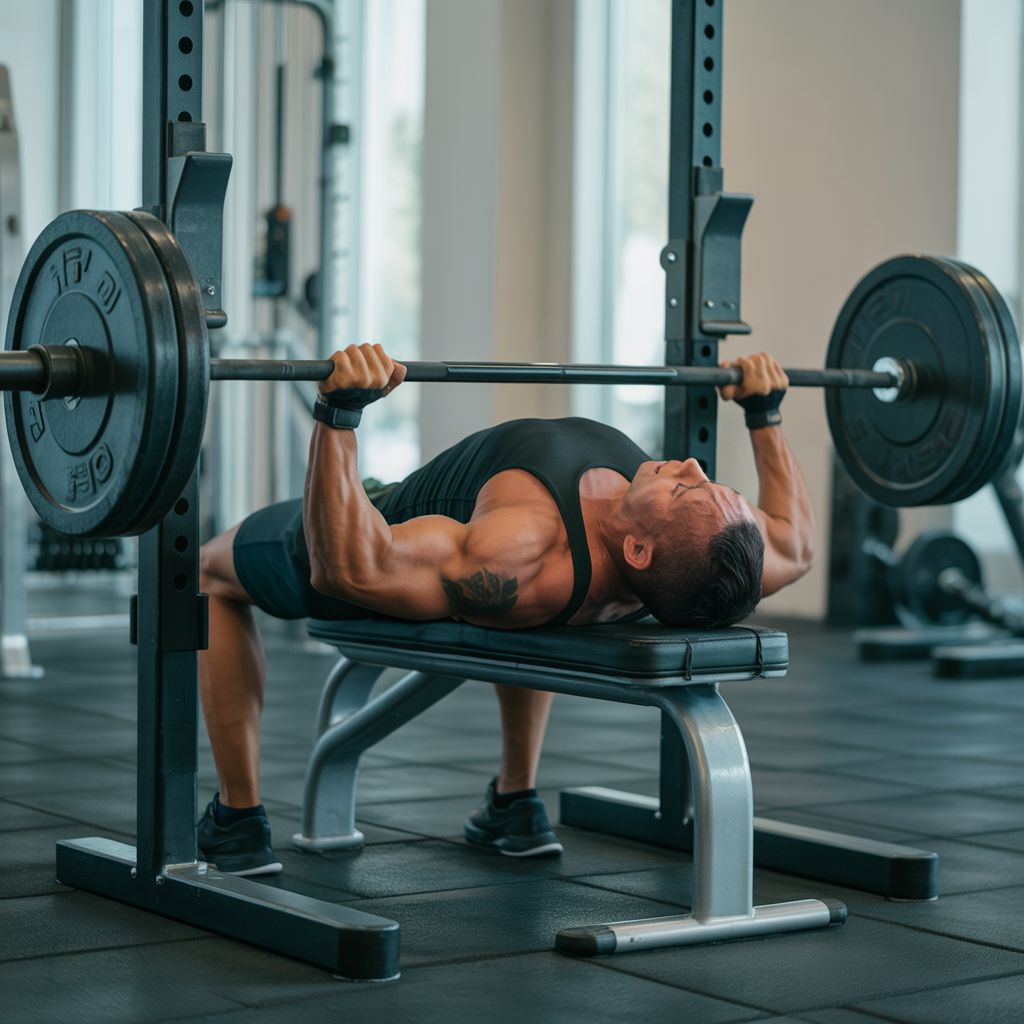
- Barbells and weight plates: Essential for heavy compound movements like bench presses
- Dumbbells: Offer greater range of motion and unilateral training benefits
- Cable machines: Provide constant tension and versatile angle adjustments
- Adjustable bench: Allows for flat, incline, and decline positioning to target different chest areas
Home and Bodyweight Alternatives
Don’t have access to a gym? No problem. Effective chest workouts can be achieved with minimal equipment:
- Resistance bands: Portable and versatile for various pressing and fly movements
- Push-up variations: The foundation of bodyweight chest training
- Dip station or parallel bars: Excellent for targeting lower chest and adding intensity
Top Pectoral Exercises by Category
The most effective approach to chest training involves combining compound exercises for mass building with isolation exercises for muscle definition and targeting specific areas.
Compound Exercises: The Foundation of Chest Development
Bench Press Variations
The bench press remains the gold standard for chest development, allowing you to handle the heaviest weights and stimulate maximum muscle growth.
Flat Bench Press: Position yourself on a flat bench with feet planted firmly on the floor. Grip the barbell slightly wider than shoulder-width, lower it to your chest with control, and press it back up in a straight line. Focus on keeping your shoulder blades retracted and maintaining a slight arch in your back.
Incline Bench Press: Set the bench to a 30-45 degree angle to emphasize the upper chest. The movement pattern remains similar to the flat bench press, but the angle shifts emphasis to the clavicular head of the pectoralis major.
Decline Bench Press: With the bench set to a decline angle, this variation targets the lower chest region and allows many people to handle heavier weights due to improved leverage.
Dumbbell Press Variations
Dumbbell presses offer several advantages over barbell movements, including greater range of motion, improved muscle activation, and the ability to address strength imbalances between sides.
Each dumbbell press variation (flat, incline, decline) follows similar principles to their barbell counterparts but allows for a deeper stretch at the bottom of the movement and more natural arm positioning.
Push-Up Variations: The Ultimate Bodyweight Exercise
Push-ups are incredibly versatile and can be modified to challenge any fitness level:
- Standard Push-Ups: The foundation movement with hands positioned slightly wider than shoulders
- Incline Push-Ups: Hands elevated on a bench or step, perfect for beginners
- Decline Push-Ups: Feet elevated to increase difficulty and target upper chest
- Diamond Push-Ups: Hands forming a diamond shape to emphasize triceps and inner chest
- Wide-Grip Push-Ups: Hands positioned wider to target outer chest areas
Isolation Exercises: Fine-Tuning Your Chest
Dumbbell Flyes
Flyes provide an excellent stretch for the chest muscles and help develop the “tie-in” between the chest and shoulders. Perform these with controlled movements, focusing on the squeeze at the top of the movement while maintaining a slight bend in your elbows throughout.

Cable Exercises
Cable machines offer constant tension throughout the entire range of motion, making them excellent for isolation work:
- Cable Crossovers: Adjustable angles allow targeting of upper, middle, or lower chest
- Cable Flyes: Similar to dumbbell flyes but with consistent resistance
- Single-arm Cable Press: Excellent for addressing imbalances and core engagement
Machine Exercises
Chest machines provide stability and safety, making them ideal for beginners or when training to muscle failure:
- Pec Deck/Chest Fly Machine: Isolates the chest while removing stabilization requirements
- Chest Press Machine: Allows for safe heavy pressing without a spotter
Advanced and Specialty Exercises
For experienced trainers looking to add variety and challenge:
- Dips: Lean forward slightly to emphasize chest over triceps
- Pullovers: Target the chest from a unique angle while also engaging the lats
- Landmine Press: Provides a natural pressing path and core engagement
Proper Form and Technique Guidelines
Regardless of which exercises you choose, proper form is non-negotiable for both safety and effectiveness. Poor technique not only increases injury risk but also reduces the stimulus to your chest muscles.
Universal Principles for All Chest Exercises
Breathing Technique: Inhale during the lowering (eccentric) phase and exhale during the pressing (concentric) phase. This helps maintain core stability and provides power for the lifting portion.
Mind-Muscle Connection: Focus on feeling the chest muscles working throughout each repetition. This conscious engagement improves muscle activation and development.
Range of Motion: Use the fullest range of motion that your mobility allows while maintaining proper form. This maximizes muscle fiber recruitment and promotes flexibility.
Tempo and Control: Lower weights with control (2-3 seconds), pause briefly at the bottom, then press with power. This controlled tempo increases time under tension and muscle development.
Safety Considerations
Always begin with a proper warm-up including light cardio and dynamic stretching. Progressive overload should be gradual – increase weight, reps, or sets by small increments to allow your body to adapt safely.
Use a spotter when attempting heavy weights, especially on barbell exercises. If training alone, consider using safety bars or dumbbells instead of barbells for maximum weight attempts.
Common Mistakes to Avoid
- Poor Shoulder Positioning: Keep shoulders back and down, avoiding excessive forward positioning
- Incomplete Range of Motion: Don’t sacrifice range for heavier weight
- Using Momentum: Control the weight throughout the entire movement
- Neglecting Balance: Train both horizontal and vertical pressing patterns
Programming Your Pectoral Workouts
The key to successful chest development lies in progressive programming that matches your experience level and allows for proper recovery between sessions.
Beginner Routine (2-3 Times Per Week)
New to chest training? Start with this foundation routine:
- Exercise Selection: 3-4 exercises per session focusing on basic movements
- Sets and Reps: 3 sets of 8-12 repetitions for each exercise
- Rest Periods: 60-90 seconds between sets
- Progression: Increase weight when you can complete all sets with perfect form
Sample beginner workout: Push-ups (or incline push-ups), dumbbell press, dumbbell flyes, and dips (assisted if necessary).

Intermediate Routine
After 3-6 months of consistent training, intermediate trainees can handle increased volume and complexity:
- Frequency: 2 times per week with higher volume sessions
- Exercise Variety: 4-6 exercises incorporating different angles and equipment
- Sets and Reps: Varying rep ranges (6-8 for strength, 8-12 for hypertrophy, 12-15 for endurance)
- Advanced Techniques: Introduction of supersets and drop sets
Advanced Routine
Experienced lifters can implement specialization techniques and higher intensity methods:
- Periodization: Cycling through different focus periods (strength, hypertrophy, endurance)
- High-Intensity Methods: Drop sets, rest-pause sets, and cluster sets
- Specialization: Focusing on lagging areas with increased volume and frequency
Targeting Specific Chest Areas
While you cannot completely isolate different regions of the chest, you can emphasize certain areas through exercise selection and angle manipulation.
Upper Chest Development
The upper chest often lags in development and requires specific attention. Focus on incline pressing movements (30-45 degrees), incline flyes, and reverse-grip pressing. These exercises place the shoulder in a position that maximally activates the clavicular head of the pectoralis major.
Lower Chest Emphasis
Decline pressing movements and dips effectively target the lower chest region. When performing dips, lean slightly forward and focus on a deep stretch at the bottom of the movement.
Inner Chest Definition
Close-grip pressing movements and cable crossovers with the cables set high help develop the inner chest region. Focus on squeezing the chest muscles at the peak contraction of these movements.
Outer Chest Width
Wide-grip pressing movements and fly variations with a focus on the stretch position help develop chest width. Dumbbells often provide better outer chest activation due to their increased range of motion.
Progression Strategies and Breaking Plateaus
Continuous improvement requires strategic progression and the ability to overcome training plateaus when they occur.
Progressive Overload Methods
- Weight Progression: Gradually increase the resistance used
- Volume Progression: Add sets or exercises over time
- Density Progression: Reduce rest periods between sets
- Range of Motion Progression: Increase the stretch and squeeze
Breaking Through Plateaus
When progress stalls, consider these strategies:
- Exercise Rotation: Substitute similar movements every 4-6 weeks
- Tempo Changes: Vary the speed of your repetitions
- Rep Range Variation: Cycle through different repetition ranges
- Deload Weeks: Reduce volume by 40-50% every 4-6 weeks
Recovery and Complementary Training
Optimal chest development occurs not just during your workouts, but during recovery periods when your muscles adapt and grow.
Recovery Guidelines
Allow 48-72 hours between intense chest sessions to ensure adequate recovery. Quality sleep (7-9 hours nightly) and proper nutrition are crucial for muscle repair and growth.
Complementary Training
Balance your chest training with pulling exercises to maintain shoulder health and posture. Back exercises, rear deltoid work, and rotator cuff strengthening should accompany any chest-focused program.
Nutrition for Muscle Growth
Adequate protein intake (0.8-1.2 grams per pound of body weight) supports muscle repair and growth. Time protein consumption around your workouts for optimal recovery, and maintain adequate hydration throughout your training.
Troubleshooting Common Issues
Addressing Muscle Imbalances
If one side of your chest is noticeably stronger or larger, incorporate unilateral exercises like single-arm presses and flyes. Always start with your weaker side and match the repetitions with your stronger side.
Overcoming Training Plateaus
Plateaus are normal parts of the training process. When progress stalls, assess your program for adequate variety, progressive overload, and recovery. Sometimes taking a week off or dramatically changing your routine can restart progress.
Injury Prevention and Management
Common chest training injuries include shoulder impingement and pectoral strains. Always warm up properly, use appropriate weights for your fitness level, and listen to your body. If pain occurs, consult with a qualified healthcare professional or certified trainer.
Some individuals may need to modify or avoid certain exercises due to shoulder issues or previous injuries. Alternative exercises and movement patterns can usually accommodate most limitations while still providing effective chest training.
Conclusion
Building impressive pectoral muscles requires a combination of the right exercises, proper technique, progressive programming, and patience. The exercises outlined in this guide provide a comprehensive toolkit for developing strength, size, and definition in your chest muscles, whether you’re training at home or in a fully equipped gym.
Remember that consistency trumps perfection – it’s better to perform simpler exercises regularly with good form than to attempt advanced techniques sporadically. Start with the basics, master the fundamental movement patterns, and gradually progress to more challenging variations as your strength and experience grow.
Your chest development journey is unique to you, so be patient with the process and celebrate the small victories along the way. Focus on proper form, listen to your body, and don’t hesitate to seek guidance from qualified fitness professionals when needed. With dedication and the right approach, you’ll build the strong, well-developed chest muscles you’re working toward.
Begin today with exercises appropriate for your current fitness level, stay consistent with your training, and trust in the process of gradual improvement. Your future self will thank you for the investment you make in your health and strength starting now.